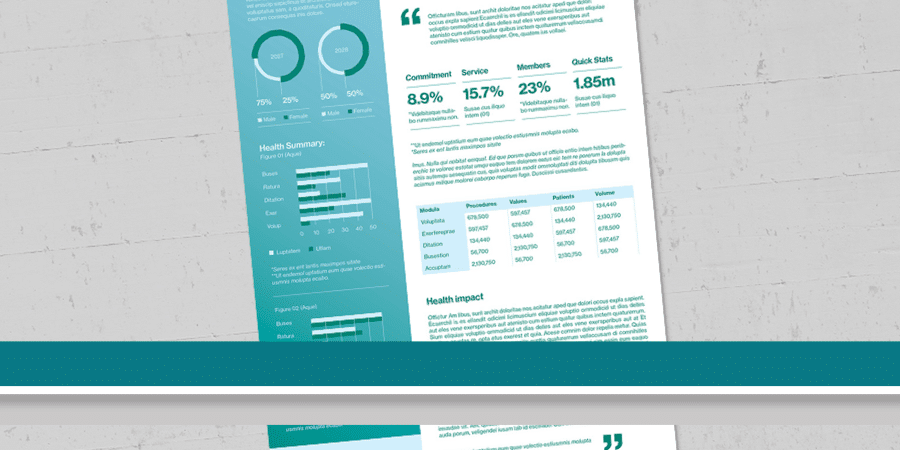
Your fund fact sheet is probably useless, and you either don’t know it or don’t care. Many asset manager fact sheets look like they were built to satisfy your compliance department, not motivate prospects or clients.
This article explains the common mistakes asset managers make when developing and distributing fact sheets, and how you can build or rebuild yours into an effective sales tool.
How to Make a Great Fund Fact Sheet
Ask most executives at asset management firms why they produce a fact sheet, and you may hear some version of “because we have to, or “because we’ve always done it.” Few expect their fact sheets to persuade anyone.
An advisor who wants to screen or rank your fund’s returns, performance vs. benchmarks, standard deviation, risk characteristics, turnover ratio, or any other salient data can pull it all in seconds from Morningstar, Bloomberg, FactSet, their home-office research department, or other data services. The same screening tools are available for platform gatekeepers and individual advisors.
Your prospects and clients do not need your fact sheet to get the facts.
If your document only repeats numbers they already have access to elsewhere, you give them no reason to read your version. The facts alone are not your advantage. What you say about them is.
For emerging and boutique asset managers, your fact sheet’s job is to tell a story they can’t get from a database.
Ten Things Money Managers Get Wrong About Fact Sheets
Below are ten mistakes money managers often get wrong about their fact sheets, along with the pushback we typically hear from managers, and what firms can do to change their perspective.
Not saying what problems you solve
We recently asked an investment firm how they help allocators solve problems. “We don’t solve problems, we pick stocks,” they told us. Well, they may never solve problems thinking like that. Firms need to think of themselves as problem-solvers. Great stock picking is important, of course, but the picking is the mechanism, not the reason a client will hire and stay with you.
If you can’t name the problem your strategy addresses, you’re asking potential client to do that work themselves, and many won’t bother.
Forgetting to say who the fund strategy is for
Many investment managers we talk to tell us that including a section about who the fund is for is superfluous. They may say something like, “Everyone can use our strategy. Why narrow it down?” Our position is that a fact sheet written for everyone convinces no one. Advisors and allocators are trying to match a strategy to a specific client need. Naming the fit does that work for them.
Not talking about your investment process, or only talking about your process
Many managers tell us that their investment process is proprietary, and they don’t want to give away too much, if any, of their secret sauce. Other managers only want to talk about their investment process, and nothing else.
In either case, there’s a wide gap between giving away your edge and providing your potential client nothing to evaluate. Most firms can describe their research, buy-and-sell discipline, and risk-mitigation strategy without revealing sensitive information.
Writing to the wrong audience
Advisors and allocators often have short attention spans, little patience, and limited tolerance for jargon. Some funds are run by portfolio managers who founded the firm, and they write as if other portfolio managers are their audience.
Their readers, often skilled at building relationships and closing sales, don’t want to take the effort to translate portfolio manager talk into text they understand. The obvious solution is to write directly, without fluff, to the decision-makers who are their audience. Instead of “drawdowns,” “exposures,” “inflection points,” or “investor sentiment,” use plain English: “losses,” “portfolio holdings,” “turning points,” and “how investors feel.”
Focusing on the wrong performance data
Many asset managers use an industry-standard “growth of $10,000” mountain chart to illustrate long-term performance. But if your strategy has a $250,000 or larger minimum investment, a $10,000 illustration does not reflect the client relationship you want. Other managers insist on using performance measures that don’t support their story, such as including sector holdings when sector weights have little to do with how they invest.
Talking about your experience the wrong way
“We have more than 100 years of combined investment experience,” appears on countless fact sheets. An advisor’s likely response: “So what? Every manager says that.” Instead of adding up years, explain what your team’s experience helps it do for clients.
Not including your tagline, or providing a bad one
Some money managers came to us without a tagline or a totally generic phrase they think passes for a descriptive shorthand for who they are, what they do, and how they are different. “Our tagline says who we are,” they said. “Plus, this is a fact sheet, not a positioning piece.” A good tagline, however, can give people a reason to want to know more. The tagline is your headline. The fact sheet should provide the proof.
Thinking of design as an afterthought, if at all
Your fact sheet should guide readers from what the fund does, to who it’s for, to how it has performed, to the details they need to evaluate you. Easy-to-understand headings, readable charts, and a logical order help allocators and advisors find answers quickly. If they have to search the page to understand your strategy, your design needs work.
Nine Frequently Asked Questions About Fund Fact Sheets
How many pages should a fact sheet be?
There is no hard rule about how many pages a fact sheet should be. As the architectural saying goes, form (and length) should follow function. Say what you want to say, and the length will be the length. Many fact sheets run two pages. If you include manager commentary, investment process, and the problems you solve, you may go longer.
How frequently do separate account managers need to publish GIPS reports?
GIPS standards require composite performance presentations at least annually, though many firms distribute them quarterly. If you produce quarterly fact sheets, your GIPS reports must be updated quarterly as well, and distributed alongside the fact sheet.
What do institutional allocators look for in a fact sheet that retail advisors and high-net-worth investors don’t?
Institutional allocators may want to know more about your process than performance, how you make decisions, who is on the team, and what happens when the strategy underperforms. Retail advisors and investors may focus more on your numbers.
Should portfolio manager commentary be included in a fact sheet?
A manager commentary section may differentiate your fact sheet from the generic data third-party providers already supply. Many advisors value this section because the commentary can provide credibility and personality that the data does not have on its own.
The downside is that writing thoughtful portfolio commentary takes time from someone whose job is managing money, not writing. And if the PM isn’t trained in communications, the result can be dense, jargon-heavy prose that does little to set your fact sheet apart.
How should compliance be involved in the fact sheet process?
Firms that treat compliance as a partner rather than an obstacle could be more likely to end up with compliant and compelling fact sheets.
Who should automate fact sheet production?
Many large fund families with dozens or hundreds of funds, strategies, and asset classes should, and indeed already have, automated their production process. Automation buys consistency, speed, and, theoretically, fewer typos and disclosure inconsistencies. However, firms that automate may end up with rigid, dull, brand-less, soul-less documents.
How should fact sheets be distributed?
Many firms post the most up-to-date fact sheet as a PDF on their website and call it a day. Some forward-thinking managers create interactive versions that can bring historical data and comparisons to life. If you don’t do so already, you can also email the fact sheet as part of your newsletter to clients and high-value prospects. Printed fact sheets as leave-behinds have gone the way of the dodo bird.
Can AI help create fact sheets?
Yes, AI can help firms both start and complete the fact sheet design process in minutes, much to the possible delight or chagrin of firm executives and graphic designers. AI can create a layout or generate a handful of ideas if you’re not sure where to start.
But treat your AI product as a rough draft. AI-generated layouts may come without the production specs, and bleed and margin requirements required for print production. A real person still needs to verify what AI doesn’t know to look for, and to make sure the finished piece looks and sounds like your firm.
How do you know if our fact sheet is impactful?
Consider both quantitative and qualitative responses. Quantitatively, track how often your fact sheet has been downloaded, how long people look at it, and if meeting requests increase after you send it. Qualitatively, ask clients directly or via survey: Does our fact sheet answer your questions? Does it leave you feeling more informed and reassured? Would they forward it to a colleague?
The Facts on Fact Sheets
A useful fact sheet helps advisors and allocators understand the problems your strategy addresses, who it’s for, how you invest, and why your firm is different from the dozens of others competing for the same allocation.
Many fact sheets fail this test, not because the data is wrong, but because the story is missing or misaligned. A fact sheet built the right way reports on your fund, but sells it, too. Those are the facts.
Schedule a complimentary strategy session with Dan Sondhelm, CEO of Sondhelm Partners, to review your content marketing strategy, including fact sheet production and distribution.
Frank Serebrin is the Content Marketing Director for Sondhelm Partners. He leads strategic and creative content and marketing services for our asset management and wealth management clients.
Connect

